Spotlight On: Endometriosis/Reproductive Surgery


This month we cast a spotlight on articles, SurgeryU videos, and Journal of Minimally Invasive Gynecology (JMIG) article recommendations from the AAGL Endometriosis/Reproductive Surgery Special Interest Group (SIG) led by Chair, Ted T.M. Lee, MD.
Access to SurgeryU and JMIG are two of the many benefits included in AAGL membership. The SurgeryU library features high-definition surgical videos by experts from around the world. JMIG presents cutting-edge, peer-reviewed research, clinical opinions, and case report articles by the brightest minds in gynecologic surgery.
SurgeryU video and JMIG article recommendations by our SIGs are accessible by AAGL members only. For full access to SurgeryU, JMIG, CME programming, and member-only discounts on meetings, join AAGL today!

SIG Recommended SurgeryU Video #1:
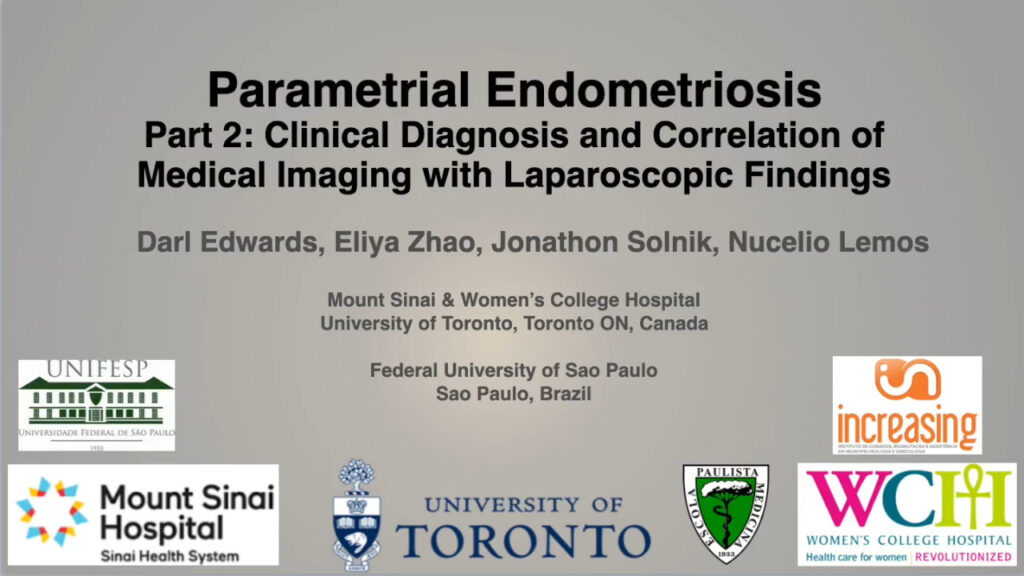
Parametrial Endometriosis Part 2: Clinical Diagnosis and Correlation of Medical Imaging with Laparoscopic Findings
By Darl Edwards MD, Eliya Zhao MD, Meir J. Solnik, MD, and Nucelio Lemos, MD
This video explores the clinical presentation of parametrial endometriosis and correlates imaging findings with laparoscopic anatomy. It demonstrates how preoperative imaging and clinical symptoms should guide surgical planning for complex deep-infiltrating disease. The video provides important insights into recognizing parametrial disease patterns that may otherwise be missed.
 Click Image to View Video
SIG Recommended SurgeryU Video #2:
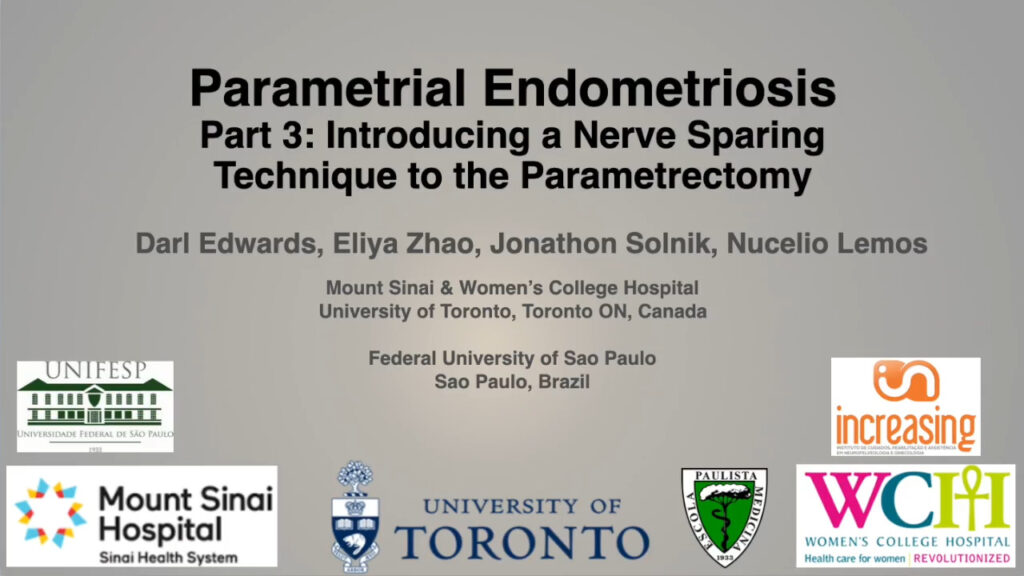
Parametrial Endometriosis Part 3: Nerve-Sparing Parametrectomy
By Darl Edwards MD, Eliya Zhao MD, Meir J. Solnik, MD, and Nucelio Lemos, MD
This video reviews key pelvic anatomy and demonstrates a structured nerve-sparing technique for excision of parametrial endometriosis. It highlights the importance of identifying pelvic nerves and maintaining safe dissection planes while removing deep disease. The video emphasizes the level of surgical expertise often required to achieve complete excision while preserving pelvic function.
 Click Image to View Video
SIG Recommended SurgeryU Video #3:
Ultrasound in the Surgeon’s Hands
Mathew Leonardi, MD, PhD, Lauri Silver Hochberg, MD, and Yvette S. Groszmann, MD, MPH, FAIUM.
This session demonstrates how ultrasound can be used to identify the extent of endometriosis prior to surgery. By utilizing these techniques, surgeons can more effectively counsel patients, fully prepare for complex procedures, and optimize patient outcomes.
 Click Image to View Video
SIG Recommended SurgeryU Video #4:
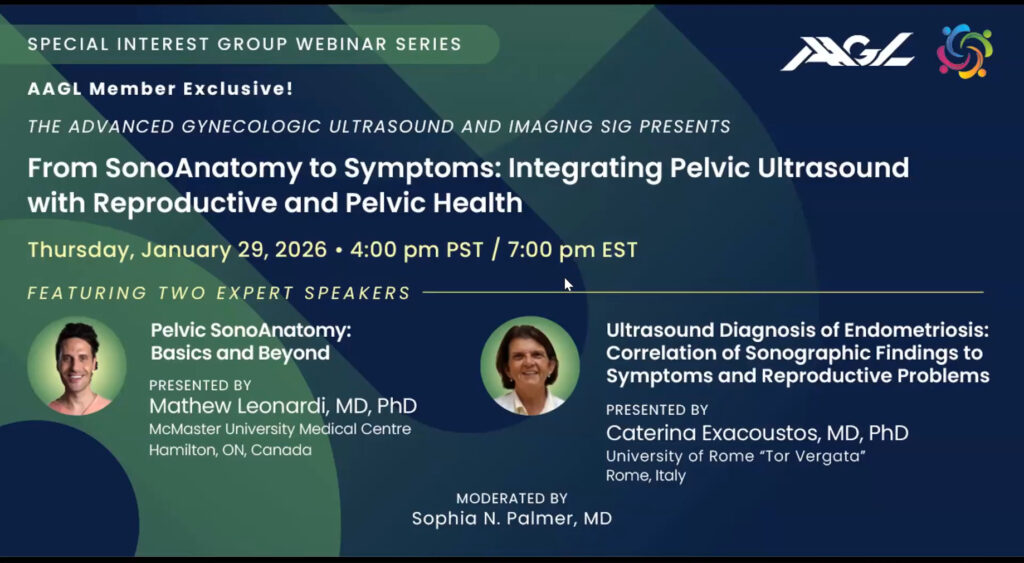
Advanced Gynecologic Ultrasound and Imaging SIG Webinar: From SonoAnatomy to Symptoms: Integrating Pelvic Ultrasound with Reproductive and Pelvic Health
By Mathew Leonardi, MD, PhD, Caterina Exacoustos, MD, PhD, Sophia N. Palmer, MD (Moderator)
The authors simplify a complex topic while reinforcing the concept of preoperative disease identification and surgical planning to optimize patient outcomes. This is video 1 of a 3 part series of videos by the authors.
 Click Image to View Video
Jessica Opoku-Anane, MD, MS
Victoria Vargas, MD, MS


Dr. Opoku-Anane is a member of the AAGL Endometriosis/Reproductive Surgery SIG and the AAGL Board of Directors. She is also Associate Professor and Section Chief of Benign Gynecological Surgery at Rutgers Health, Robert Wood Johnson Medical School in New Brunswick, New Jersey.

JMIG Article Recommendation #1:
Ted Lee, MD, Mauricio Abrão, MD, Mindy Christianson, MD, Shannon Cohn, JD, Humberto Dionisi, MD, Rebecca Flyckt, MD, Shaheen Khazali, MD, Cara R. King, DO, MS, Louise King, MD, JD, Nucelio Lemos, MD, PhD, Nash Moawad, MD, MS, Megan Orlando, MD, Sukhibr S. Singh, MD, Smitha Vilasagar, MD
In honor of Endometriosis Awareness Month, the Endometriosis SIG is highlighting the recently published white paper from the AAGL Endometriosis Care Quality Collaborative Taskforce.
This paper establishes a framework for comprehensive endometriosis care, emphasizing the necessity of multidisciplinary teams and high-level expertise in both surgical and clinical settings. It also underscores the critical role of research in advancing patient care. This work is essential to establishing a higher standard of care for patients living with endometriosis.
JMIG Article Recommendation #2:
Diagnostic Disparities in Endometriosis and Adenomyosis: Investigating Social Vulnerability and Access to Care in an Ancestrally Diverse Population
Leigh A. Humphries, MD, MSCE, Margaret A. Rush, MD, Meridith Pollie, MD, Lindsay Guare, BS, Chelsea Okeh, BS, Shefali Setia Verma, PhD, and Suneeta Senapati, MD, MSCE
The researchers found that the prevalence of endometriosis does not vary by ancestry group, meaning patients of African Ancestry did not have a lower prevalence of endometriosis. However, the study revealed that patients of African ancestry were less likely to receive a surgical diagnosis and, consequently, necessary therapeutic interventions. Further, the odds of receiving a surgical diagnosis decreased as socioeconomic vulnerability increased.
This study underscores the pervasive inequities that patients of color face when seeking treatment for endometriosis, the importance of acknowledging this reality, and our responsibility to make all efforts to address inequities in our field.
JMIG Articles Recommendations By:
Victoria Vargas, MD, MS

Dr. Vargas is a member of the AAGL Endometriosis SIG and a Partner at Washington Endometriosis and Complex Surgery in Washington, DC.

Obturator Nerve Endometriosis: An Uncommon Cause of Cyclic Medial Thigh Pain
While endometriosis most commonly presents with pelvic pain and dysmenorrhea, involvement of pelvic nerves can produce atypical symptoms that delay diagnosis for years. In recognition of Endometriosis Awareness Month, the Endometriosis / Reproductive Surgery SIG highlights the importance of recognizing these uncommon presentations.
A 34-year-old patient was referred for evaluation of severe cyclic pain radiating down the medial aspect of her left thigh. The pain had been present for several years and consistently worsened during menses. She had undergone extensive evaluation by orthopedics and neurology, including lumbar spine imaging and physical therapy, without a clear diagnosis. Her symptoms had been attributed to musculoskeletal strain.
Because of the cyclic nature of her symptoms and the distribution of the pain, endometriosis involving the obturator nerve was suspected. Pelvic MRI tailored for deep endometriosis demonstrated a nodular lesion along the left pelvic sidewall extending into the obturator space.
At laparoscopy, deep endometriosis was identified along the pelvic sidewall within the obturator fossa. After developing the paravesical space, dissection was carried laterally, where the obturator nerve and vessels were exposed. Dense fibrotic tissue encased the nerve, consistent with endometriotic infiltration. Using a nerve-sparing approach, the lesion was carefully dissected away from the nerve and excised. Additional endometriosis involving the uterosacral ligament and pelvic peritoneum was also excised. Postoperatively, the patient experienced complete resolution of her cyclic medial thigh pain.
This case illustrates how endometriosis involving pelvic nerves can mimic orthopedic or neurologic disease and lead to delayed diagnosis. Recognition of cyclical symptoms, advanced imaging, and specialized surgical expertise are essential for identifying and safely treating these rare presentations.
About the Author:
Jessica Opoku-Anane, MD, MS

Dr. Opoku-Anane is a member of the AAGL Endometriosis/Reproductive Surgery SIG and the AAGL Board of Directors. She is also Associate Professor and Section Chief of Benign Gynecological Surgery at Rutgers Health, Robert Wood Johnson Medical School in New Brunswick, New Jersey.

Technology Update for the Endometriosis Special Interest Group Ziwig Endotest™ — Real-World Implications, Including Cost, Access, and Clinical Context
Recent advances in molecular diagnostics have introduced the Ziwig Endotest, a saliva-based microRNA assay developed by Ziwig for the non-invasive diagnosis of Endometriosis. Early validation studies report very high sensitivity and specificity, raising enthusiasm for the possibility of shortening the long diagnostic delay associated with endometriosis. While these results are promising, the real-world implications of introducing a highly accurate diagnostic test extend beyond test performance and include issues of clinical context, cost, access, and interpretation.
A highly sensitive test may allow earlier identification of patients who truly have endometriosis, potentially facilitating earlier medical therapy, improved counseling, and better referral to experienced surgeons. However, the predictive value of any diagnostic test depends on pre-test probability, a principle explained by Bayes’ theorem. Even a test with excellent sensitivity and specificity may generate false-positive results when used in populations with low disease prevalence. For this reason, indiscriminate testing in patients with nonspecific pelvic pain, gastrointestinal symptoms, or dysmenorrhea without supporting clinical findings may lead to overdiagnosis rather than improved care.
Equally important is the distinction between the presence of disease and the cause of symptoms. Endometriosis is common, and not all detected lesions are clinically relevant. A positive biomarker confirms the presence of endometriosis-associated molecular signals, but it does not prove that the patient’s pain, infertility, or other symptoms are caused by endometriosis. Chronic pelvic pain may result from multiple overlapping conditions, including adenomyosis, pelvic floor dysfunction, bladder pain syndrome, irritable bowel syndrome, or central sensitization. In such cases, attributing symptoms solely to a positive test result may lead to unnecessary hormonal therapy or surgery while the true pain generator remains untreated. Therefore, diagnosis must always be interpreted in the context of history, physical examination, and imaging findings.
Another limitation is that a molecular test does not define disease phenotype. A positive result does not distinguish between superficial peritoneal disease, deep infiltrating endometriosis, or extra-pelvic involvement, nor does it provide information about surgical complexity. As a result, imaging and clinical evaluation remain essential for treatment planning even when a biomarker test is available.
Cost and insurance coverage represent additional real-world barriers. The Endotest is expensive, and in many settings it is not covered by most insurance plans. This limits
access, creates potential disparities in care, and may place pressure on clinicians to act on a result obtained at significant out-of-pocket expense. When a test is both highly accurate and costly, appropriate patient selection becomes even more important to avoid unnecessary testing and increased healthcare expenditure without clear benefit.
In summary, the Ziwig Endotest™ represents an important technological advance with the potential to improve the diagnostic pathway for endometriosis. However, high sensitivity and specificity do not eliminate the need for clinical judgment. The presence of a diagnosis does not always mean that it is the cause of symptoms, and the value of any diagnostic test ultimately depends on careful integration with history, examination, imaging, and thoughtful clinical decision-making.
Disclaimer: Ziwig Endotest is not FDA approved.
Reference:
Bendifallah S, Dabi Y, Suisse S, et al.
Validation of a Saliva Micro-RNA Signature for Endometriosis.
NEJM Evidence. 2023;2(7):EVIDoa2200282.
About the Author:
Ted T.M. Lee, MD
Dr. Lee is Chair of the AAGL Endometriosis SIG and Director of Minimally Invasive Gynecologic Surgery and Chief of Surgical Innovation at NYU Langone Health in New York, New York.