Professional Citizenship and JMIG in My Veins: Transitions in JMIG Leadership
Professional Citizenship
Reviewing journal manuscript submissions can be viewed as an uncompensated and time-consuming task of unsung heroes. However, I would argue the perspective that it is an excellent way to keep current on the latest developments in our field. More importantly, it represents a critical opportunity, if not obligation, to support our discipline and our journal. We can thank Jason Abbott and Gary Frishman for creating pathways for us to fulfill this professional citizenship function through serving as ad hoc reviewers and editorial board members of JMIG. Indeed, as Co-Editors-in-Chief of JMIG, Jason and Gary escalated editorial stewardship to a new level by developing innovative ways to engage reviewers more actively. They provided guides to assist in the development of confidence and acumen in new reviewers and created a public recognition system to honor more seasoned reviewers who have completed milestone contributions (e.g., over 200 reviews –nothing is more stimulating than throwing a little competition into the mix)! Further, they created a system of topic-specific Deputy Editors and the “Associate Editor Training Program” to ensure JMIG’s diversity and longevity, and to groom the next generation of editorial leadership.
The Greek philosopher Heraclitus taught us in 400 BC that “change is the only constant in life” and so we must face that inevitability with JMIG. Saying farewell to Jason and Gary is bittersweet as they move on to the next iteration of their contributions to women’s health. But we should all take a moment to celebrate the realization of their vision, which expanded JMIG into an incubator for sustained excellence in leadership and transformed opportunities for us to fulfill our professional citizenship.
Thank you, Gary and Jason, for your many years of service to JMIG and for your two years as Co-Editors-in-Chief. We are a stronger journal thanks to your efforts.
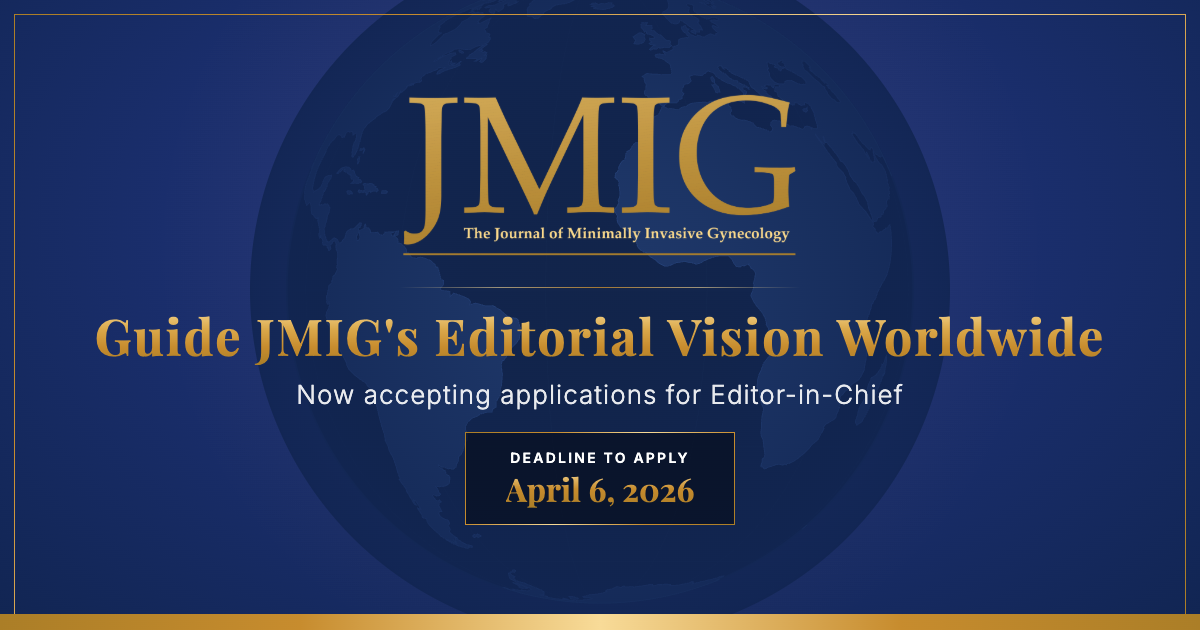
We also welcome back Dr. Tommaso Falcone, former JMIG Editor-in-Chief, 2012-2023, who will serve as Interim-Editor-in-Chief during the application and selection process of the Journal’s new Editor-in-Chief.
To learn more about the requirements of the Editor-in-Chief and to submit an application please see the 2026 JMIG Editor-in-Chief Application. Applications close April 6, 2026.
Ted Anderson, MD, PhD
2025 AAGL President
JMIG in My Veins
In this last editorial as Co-Editor-in-Chief, it is a privilege to be able to reflect on my time with the Journal and share my very exciting next steps. It is nearly 30 years since I completed my first review for JMIG – then the Journal of the AAGL. My clinical mentor at the time nominated me to undertake that first review. I was terrified that I was not up to the task; that I would make the wrong decision; or that my review would be so poor that I would never be asked to review again! Fortunately, that same mentor time guided me through the process, providing advice that I continue to use through to this day. That first review took 2 weeks to write and was longer than the article itself – it was not a sustainable practice, but definitely thorough.
Further reviews, publications of my own works and making it known I wanted to do more, led to my nomination as a board member and subsequently a contributing editor alongside Mac Munro and Barbara Levy with Stephen Corson as our Editor-in-Chief. With their expert guidance, I learned how to navigate the editorial space – a marvellously steep, terrifying and exciting learning curve.
When Tommaso Falcone took the reins in 2013, the Journal was in its 20th year of publication – a mature, leading publication in minimally invasive gynaecology. Part-way through this new board’s tenure, Tommaso and Gary Frishman invited me to become an associate editor and with their leadership, the Journal Impact Factor rose; it became a monthly periodical; and special issues emerged with focused content. JMIG was in its ascendency.
Taking over the Editor-in-Chief role was not something I was planning. My roles at UNSW in Sydney, Australia and my research took most of my time and I was wary about overpromising and underdelivering. When Gary Frishman suggested we share the EiC role, it seemed a great choice, we had complementary skill sets, and it meant the time requirement would be shared. Together we set a bold agenda for our tenure, leading out with a completely new editorial team and having the dual drivers of research quality and training the next generation as our mantra. We had committed to one 5-year term and reset governance, revamped policies and procedures, and proposed new paths for the Journal. Some, like the complete rebranding of the journal (the colour, styling and dissemination) never came to fruition (perhaps a bit too bold and way too ambitious) but others such as the collection series, reviewer spotlight, associate editor training program, portfolio allocation and strategic planning days were embedded in our version of the Journal. Most of this was achieved with, and by our incredible deputy editorial team whose Herculean efforts meant our brainstorming ideas became reality. Most of our success has to do with their dedication and commitment to excellence.
But sometimes you get surprises in life. For me, a series of events happened in the endometriosis research space with my charity work, advocacy, government representation, and longstanding commitment to clinical and scientific research in endometriosis landing a $50,000,000 research program grant. As someone who has whinged all their academic life about not having enough research support for endometriosis, the gifting of this grant to found and be a director of the Ainsworth Endometriosis Research Institute across Australia is the pinnacle of my research career. It is an extraordinary, great surprise, but it needs my complete attention.
That has meant making the very difficult decision to leave my JMIG leadership position halfway through my tenure. It definitely feels like unfinished business, but it turns out I am not superhuman and cannot continuously add workload and burden in my professional life. Who knew? (and why didn’t someone tell me earlier!) So, with a combination of sadness at departing earlier than anticipated, but happiness in all that we have done together, I must thank Michael Wynn-Williams, Carla Tomassetti, Mandy Yunker, Mireille Truong, Dario Roque, Afshin Fazel, Siddhi Mathur, Suzie As-Sanie and Adrianne Dade – our exceptional deputy editorial team. To Linda Michels, Kathy McMahon and Andrea Boccelli for their support and advice on all managerial and editorial matters. Finally, to Gary Frishman, my Co-Editor-in-Chief – we set a cracking pace and have achieved so much together! It is through and with all these people and experiences that JMIG has been sewn into the fabric of my academic life. It will forever run through my veins, and I cannot wait to see where it goes to next.
Jason Abbott, B Med (Hons), PhD
JMIG Co-Editor-in-Chief, 2023-2025