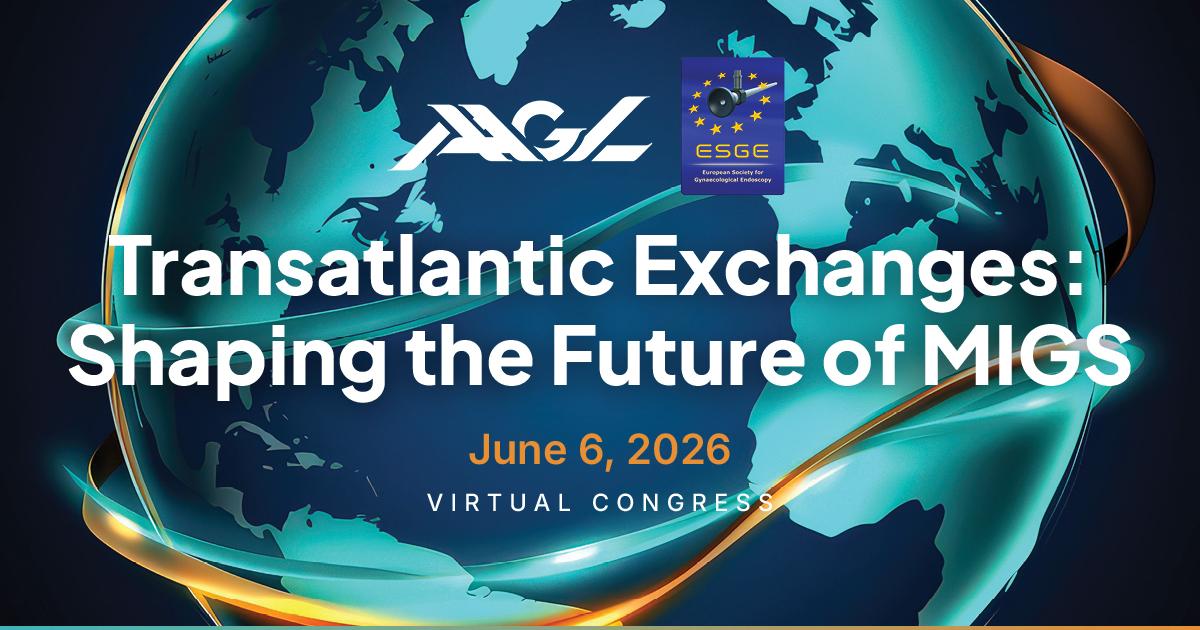
Transatlantic Exchanges: Shaping the Future of MIGS
It is with genuine excitement that we share with you what is a landmark moment in the history of minimally invasive gynecologic surgery: The first-ever joint virtual congress between AAGL and the European Society for Gynaecological Endoscopy (ESGE).
AAGL and ESGE are the two largest minimally invasive gynecologic surgery societies in the world. Together, we represent thousands of surgeons across nearly every continent. And yet, for all the progress our fields have made individually, we have never shared a single stage — until now.
The partnership between our two societies has been building momentum. The energy and collegiality at each of our individual Congresses and our joint webinar series has made clear that this relationship is something special. A joint congress — with full programming, live access for members of both societies, and a shared scientific vision — is an elevated level of partnership. It is a unified front, and it sends a message to the field that the future of MIGS is not American or European. It is both.
We share a common objective of education, training and exchange of scientific knowledge and innovation in the field of gynaecological endoscopy to advance women’s health. The two societies have worked together over the years to reach this objective by organizing joint webinars, publishing recommendations and practice guidelines, and making presentations at each other’s events. This year, the AAGL and ESGE are planning to go one step further and have planned a Virtual Congress entitled ‘Transatlantic Exchanges: Shaping the Future of MIGS’. This Virtual Congress will be available live to the members of both societies. It will take place on Saturday, June 6, 2026, 6:00am-12:00pm PDT (3:00pm-9:00pm CET, 9:00am-3:00pm EDT). Members of either society can learn more about the Scientific Program and register to attend through the Virtual Congress Website.
When experts on both sides of the ocean define the role of emerging technologies, joining human intelligences is a moral duty. Surgical diagnosis, ways of access and of new less invasive treatments will be influenced and transformed by augmented reality, fluorescence, and new instruments including articulated instruments and or new robotic platforms. This low carbon collaboration paves the road for future environmentally friendly meetings.
The program reflects the full breadth of our field. The anatomy session will reimagine pelvic anatomy for modern MIGS in the era of innovation. The hysteroscopy session will cover topics such as enhanced fertility surgery and fertility-preserving approaches. Oncology will cover guidelines and perspectives for minimally invasive surgery in gynecologic oncology. The Endometriosis session brings together an extraordinary international faculty to address surgical management from superficial disease all the way to complex deep infiltrating cases. The Robotics session tackles one of the most provocative questions in our specialty today — whether robotic surgery will ultimately replace conventional laparoscopy — through a structured transatlantic debate. The Imaging session offers practical, high-yield guidance on integrating ultrasound and MRI into operative planning. The Neuropelveology session will cover topics such as pudendal neuralgia and pelvic pain caused by pelvic floor muscle dysfunction. And the Urogynecology session explores emerging technologies reshaping pelvic floor reconstruction, including vNOTES and single-port robotics. There is something in this program for every minimally invasive gynecologic surgeon, regardless of subspecialty focus.
Please join us on June 6th. Register Now! The future of MIGS is being written together.
About the authors:
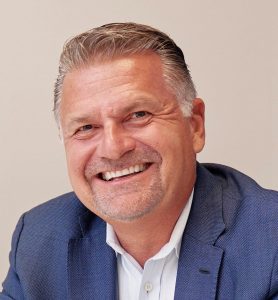 Michael Hibner, MD, PhD
President, AAGL
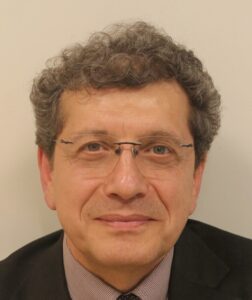 Ertan Saridogan, MD, PhD
President, ESGE
 Michel Canis, MD, PhD
Scientific Program Committee