The Person Behind the Honor: Meet the 2026 Honorary Chair
I was born in Singapore and had no particular aspiration to be a doctor as there were no friends, family or relatives who were.) From secondary school I taught myself guitar and later vibraphone, and I formed several bands and even had a permanent gig at the premier nightclub in Singapore. This continued through medical school.
I was lucky to be awarded a President Scholarship in 1962 that paid full board to the University of Singapore medical college, so I enrolled. After graduation, I married my wife, Susan, and after working a few years in Singapore, I decided to pursue OGBYN training in London because of their reputation for excellence and got a job as senior house officer (resident1 – a demotion) at the renowned Hammersmith Hospital.
Unrelated to my job, there was a registrar named Robert Winston who was pioneering gynecological microsurgery. I would visit his rabbit lab during free moments to see what he was doing. He was generous in explaining the principles he established and innovation he created. He was successful and announced the world’s first gynecological microsurgical tubal anastomosis using 8/0 suture in 1977 in the Lancet (open method).
My further experience in Obstetrics and Gynecology was in Newcastle, where our two sons, Gerald and Edward were born.
In 1977, I moved to the USA as Assistant Professor in OBGYN under Professor Richard Mattingly at the Medical College of Wisconsin – fulfilling a dream of coming to the USA because of its egalitarian and meritocratic reputation, as well as the attraction of its music, arts and film. Medically, it was already beginning to surpass the UK in medical reputation.
In the early 80’s laparoscopy was moving from a diagnostic to an operative tool. There was much excitement about the new approach. Surgeries were being invented, and opportunities existed for pioneering new approaches. The early innovative surgeons who I visited included Jim Daniel, Harry Reich, and David Redwine. From each I picked up pearls and stored something in my brain for later refinement.
My Challenge:
I decided to develop something that was thought impossible by laparoscopy then, true microsurgery using 8/0 suture. I channeled the principles that I had absorbed from Winston and working with my practice partner, Grace Janik, we worked on rabbits until perfected. Then I offered free anastomoses to the first ten patients, resulting in six pregnancies. The hospital was very encouraging and offered a fixed fee for patients as this surgery was not covered by insurance. We presented the world’s first LAPAROSCOPIC microsurgical tubal anastomosis in 1992 in London to an audience that included Robert Winston. In 1993, the Video ‘Laparoscopic Microsurgical Tubal Anastomosis Using 8/0 Suture” won first prize at the ASRM/CFS conference. Pregnancy rates of 81% were achieved in women <39 years, a result superior to ‘open’ microsurgery. In the next three consecutive years, our videos on various reproductive surgery won first prizes at ASRM.
The technique to enable this suturing evolved from experimental efforts that were tried and I called it ‘suturing in the Vertical Zone’. This technique of ipsilateral suturing was the first of its kind for laparoscopy and allowed efficient repair of many surgeries including hysterectomy, myomectomy and other reconstruction using continuous suturing with a curved needle.
I was able to create new suturing instruments for microsurgery (Koh Ultramicro instruments) followed by instruments for regular surgery (macrosurgery) based on the Vertical Zone ergonomics. The Koh macroneedleholder by Storz is the most widely used and copied in the world today.
The main focus was eliminating the ‘finger rings’ that caused nerve damage to the surgeon and was a poor instrument anyway.
TLH
After observing laparoscopic hysterectomy, I created several innovations to the approach and invented the ‘KOH cup and pneumooccluder’ and published “A New Technique and System for Simplifying TLH” (1) in the JAAGL 1998 (now JMIG).
Endometriosis
This became the new frontier of advanced laparoscopy from 1990’s when the incredible visualization afforded by laparoscopy required a matching surgical prowess to effect surgery beyond what laparotomy could achieve.
Microsurgical dissection via laparoscopy allowed precision and accuracy. With our ability to suture everything from bowel to ureter to bladder- nothing was off limits for radical excision – and this became the surgery that occupied my interest and challenge.
I formed the Milwaukee Institute of Minimally Invasive Surgery with general surgeons and urologists- and were the first to perform the EEA bowel resection for endometriosis from the 1990’s. (2). Practicing ART gives a unique insight into the role of IVF in advanced endometriosis surgery.
In incorporating microsurgery into endometriosis surgery, a new discipline was introduced to achieve both surgical as well as reproductive goals and I remain interested to this day!
Why AAGL?
I met Jordan Phillips and Linda Michels from the beginning and joined the AAGL because of the incredible stimulus it gave to the start of laparoscopic surgery. It continues to be a forum for promoting MIGS and a huge incubator for new talent.
What are you passionate about?
Professionally I always thought of laparoscopic surgery as an art form since it is so visual. So, surgery should be beautifully executed in addition to achieving its goal. Accurate surgery reduces de novo adhesion formation, as evidenced from the days of open microsurgery. The medium of laparoscopy does not allow one to operate in a bloody mess as progress would be impossible.
Furthermore, one must always strive to attain progression and innovation.
I teach laparoscopic suturing in the Vertical Zone wherever I can and continue to this day internationally.
Hobbies
My hobbies include teaching myself jazz piano (watching YouTube) and playing music with friends. I even formed a band with fellow doctors in Milwaukee. I live in Denver now near my sons and ski with them in Vail. Golfing is a family pleasure that includes my grandson, Oliver.
Professional Recognition
2009 President, Society of Laparoendoscopic Surgeons, USA.
2009 Distinguished Surgeon Award, Society of Reproductive Surgeons, American Society of Reproductive Medicine
2012 Endometriosis Foundation of America. Endometriosis Surgeon Award
2012 Society of Laparoendoscopic Surgeons. Excel Award
2012 British Society of Gynecologic Endoscopy, Sir Alec Turnbull Lecturer, Cardiff, Wales
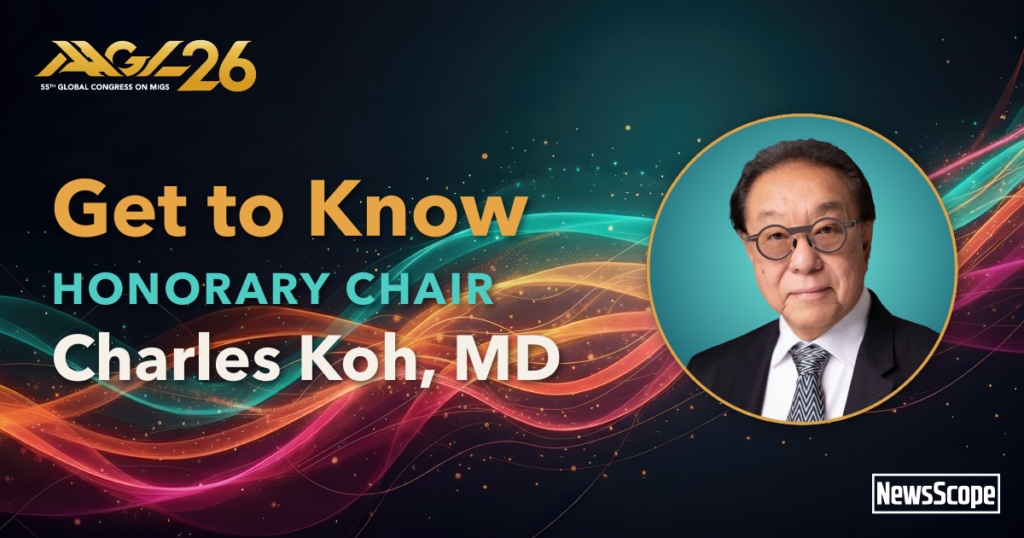
The current recognition as honorary chair at this AAGL 2026 conference is a very special award, almost like a culmination of all the previous awards I received. Most touching and meaningful is to have been nominated by Nash Moawad – whose brilliant career trajectory I have followed over the years at AAGL. Nothing will top this.
For the Next Generation of MIGS:
What you are pursuing is an amazing career – an intervention for a patient that creates relief from pain, a renewed hope for normal function and procreation- and is challenging because no two cases are alike.
That is the biggest reward that few other specialties provide.
How can you be better? I would like to describe what drives me:
- Understand the goal of the surgery.
- Keep questioning the goal.
- Examine the techniques and approaches to achieve this goal.
- IMAGINE refinements to this.
- Do not be stuck on PROCESS from HABIT or loyalty to your mentor.
Constantly review the process by watching many surgeons and create your own unique approach.
You may have invented a new process!
Finally – what has always guided my creation of surgical techniques:
First replicate faithfully, and accurately. (what was classically done at laparotomy)
Only then, innovate to exceed what was possible at laparotomy.
References
- A New Technique and System for Simplify Total Laparoscopic Hysterectomy. J Am Assoc Gyn Laparosc May 1998, 5 (2):187-192
- The surgical management of deep rectovaginal endometriosis. In: Current Opinion in Obstetrics and Gynecology, 2002, 14:357-364